
The best small-ship cruises for older travelers who want fewer crowds
Why this matters before you book
Cruise marketing tends to sell size as a feature. Bigger ship, more decks, more to do. For some travelers that is exactly right. For others, a ship carrying a few thousand passengers is the opposite of what they wanted from a cruise in the first place. Small ship cruises for older travelers solve exactly that problem.
Small ship cruises are a genuinely different kind of trip, not a scaled-down version of a large one. Before you book, it helps to know what changes, what you gain, what you give up, and what to check if mobility is a consideration for you or your travel companion.
What “small” means on small ship cruises
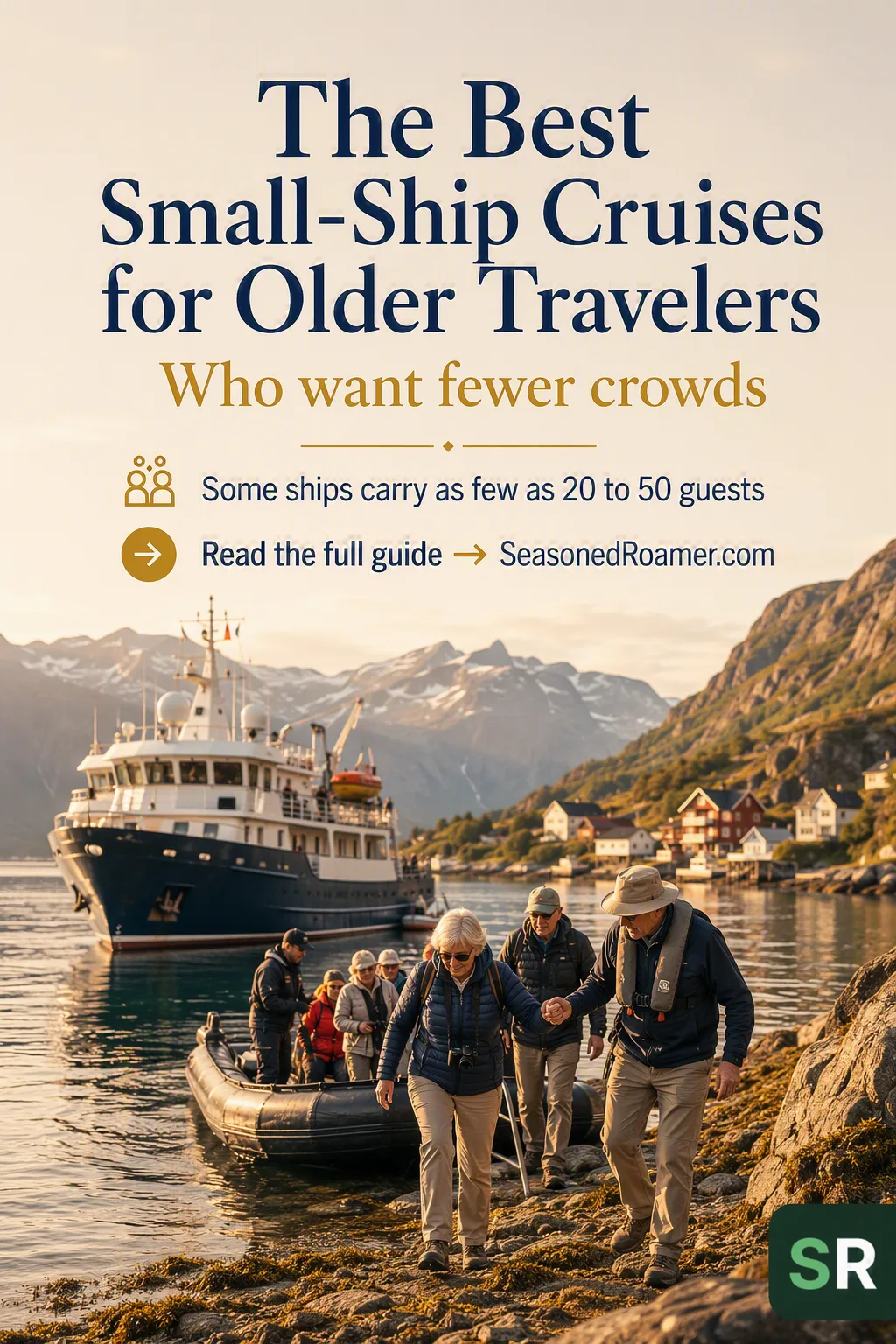
There is no single, agreed definition of a small ship in the cruise industry. Ask five different sources what counts as small and you will get five different answers. Some put the cutoff at under 250 passengers. Others go as high as under 1,000, or even under 1,599. One specialist small-ship agency sets its own working definition at 250 passengers and under, with most of the ships it deals with carrying somewhere between 20 and 50 guests.
What this means for you: do not rely on a cruise line calling its ship “small” or “intimate” in its marketing. Check the actual passenger capacity for the specific ship you are considering, and decide for yourself whether that number feels right for the kind of trip you want.
What you gain on small ship cruises
- Shorter lines. Fewer passengers means less time waiting to board, get off, or sit down for a meal.
- Access to smaller ports and harbors. Some smaller ships can dock, or land passengers directly on shore, in places a large ship physically cannot reach.
- More time in each destination. Small ship cruises tend to include longer stays and more overnight visits in port, rather than moving on after a single day.
- More personal service. Smaller ships generally run a higher ratio of crew to passengers, and by the end of the trip the crew might know you by name.
What you give up
- Fewer onboard amenities. Most small ships have one main dining room rather than several specialty restaurants, and far less in the way of theatres, casinos, or large entertainment venues.
- Less flexibility around meals. Set dining times and set tablemates are more common on smaller ships than the multiple-restaurant, come-when-you-like dining typical of large ships.
- Generally higher fares per passenger. Small and luxury expedition ships tend to cost more per person than large mainstream ships, because the cost of running the ship is spread across far fewer paying guests.
Small ship cruises vs large ships at a glance
| Smaller ship | Larger ship | |
|---|---|---|
| Waiting and lines | Shorter, with fewer passengers | Longer at boarding, leaving the ship and meals |
| Ports | Some can reach small harbours a large ship cannot | Limited to ports that can take a large ship |
| Time in port | Itineraries tend to include longer stays and overnights | More often one day per port |
| Service | Higher crew-to-passenger ratio, more personal | Less personal on a typical voyage |
| Dining | Usually one main dining room, set times more common | Several restaurants, more flexible times |
| Entertainment | Little in the way of theatres or casinos | Theatres, casinos and large venues |
| Price | Generally higher per person | Generally lower per person |
Do smaller cruise ships rock more?
There is no simple answer by size alone, and neither cruise lines nor health services give one. What they do agree on is where to sit and what to do. Fred. Olsen Cruise Lines advises that midship cabins on lower decks feel the least movement. The NHS suggests sitting in the middle of a boat and looking at a fixed point, such as the horizon. A pharmacist can recommend tablets, patches or bands before you go.
If motion is a worry, ask the cruise line about the route and time of year, and book a midship cabin on a low deck.
Do small ship cruises charge a single supplement?
Usually, yes. Cruise lines price fares per person for two people sharing a cabin. Most lines charge extra when one person books a cabin alone. Fred. Olsen Cruise Lines describes the single supplement as an extra charge for booking a twin cabin for solo use. How much it adds varies by line, ship and sailing. Neither line checked here publishes a fixed figure, so ask for the exact amount on your sailing.
Three ways to pay less when you travel alone:
- Book a cabin built for one. Fred. Olsen says it has over 40 solo cabins on Bolette and Borealis, and over 60 on Balmoral. Lindblad Expeditions offers private solo cabins on select ships and cabin categories. These cabins can sell out, so ask early.
- Ask about sharing a cabin. Lindblad’s Share and Save program pairs you with a guest of the same gender. You pay the shared-cabin rate whether or not the line finds you a roommate. It applies on select ships and cabin categories.
- Watch for solo offers. Lindblad runs reduced single supplements and solo promotions on select departures through the year. Fred. Olsen has run “no single supplement” offers on selected sailings in past sales.
Mobility and accessibility: what to check before you book
This is the part of the decision that matters most, and it does not have a simple answer. Accessibility varies a great deal between ships, and even between different ships run by the same company.
- Not every small ship has elevators. Some small and expedition ships have full accessible cabins and guest elevators. Others, particularly older or purpose-built expedition vessels, have no elevator at all, and getting between decks means using stairs.
- Many small-ship itineraries use tenders or rigid inflatable boats, often called Zodiacs, to bring passengers from ship to shore, rather than walking off onto a dock. Getting into and out of one of these usually means stepping down briefly, with crew assistance, and conditions on the day, including wind and sea state, can affect how straightforward that is.
- This is not unique to small ships. Large ships also use tenders at ports where they cannot dock directly. But small-ship, expedition-style itineraries rely on tenders and shore landings far more often than typical large-ship itineraries do.
- Cruise ships that dock at United States ports must meet Americans with Disabilities Act standards. This applies even to ships registered in other countries. That requirement does not apply at ports outside the United States. Shore excursions are less clear cut: excursions run by independent, local operators, especially outside the US, are generally not directly bound by US disability law. But the requirement is not a blanket exclusion either. The US Department of Justice has taken enforcement action against a cruise line specifically over accessibility of shore excursion transportation the cruise line organized itself, so where the cruise line runs the excursion directly, ADA obligations can still apply.
Ask the ship directly before you book
Before you book, contact the specific ship or operator directly and ask about elevators, cabin accessibility, and how landings work on the exact itinerary you are considering. Do not assume accessibility based on the cruise line’s general reputation, or on how a different ship in the same fleet is set up. If mobility is a concern for you or someone you are traveling with, this one phone call or email is worth the time before you commit.
Questions to ask before you book
Smaller operators are less well known than the big cruise lines, so it is worth knowing how to book travel safely online before you hand over a deposit.
- How many passengers does this specific ship carry, not the cruise line’s fleet in general?
- Does this ship have a guest elevator? If not, how many decks would I need to manage on stairs?
- How does this itinerary get passengers ashore at each port? Is it a dock, a tender, or a Zodiac landing?
- What assistance is available for boarding a tender or Zodiac, and is there a point at which the crew would advise against it for someone with limited mobility?
- What are the dining arrangements? Fixed times and tables, or more flexibility?
- What is included in the fare, and what costs extra? Small-ship pricing structures vary widely.
- Is there a single supplement on this sailing, how much is it, and does the ship have cabins built for one?
Before you book
- Confirm the actual passenger count of the specific ship, not a marketing description of “small” or “intimate.”
- Ask directly about elevators, cabin accessibility, and how shore landings work for the exact itinerary.
- Check what is included in the fare and what is not, since this varies more on small ships than on large ones.
- Decide what matters more to you: onboard amenities and dining variety, or closer access to ports and a more personal pace.
Three related articles worth reading. See what to expect on a Road Scholar trip and whether it is worth the price, five luxury lodges in Africa that make technology easy for older guests, and how to use Google Maps offline so you are never lost without data, worth downloading before a cruise where ship WiFi is unreliable.
For more trip planning help, see our travel guides.